
You almost always hear it before you see it.
Tell us what the door is doing. Nothing begins until you've heard the number, and hearing it is free.
You almost always hear it before you see it. A loud, sharp BANG - usually in the morning, often when you've just left for work and triggered the opener - followed by a door that either refuses to move or jerks two feet up and slams back down. That bang is the sound of a torsion spring failing, releasing several thousand foot-pounds of stored energy in a fraction of a second. It's startling, sometimes loud enough that homeowners think a gun went off in the garage.
Spring failure is the single most common garage door emergency we respond to in Pennsylvania. The reason it dominates the call volume is simple: torsion springs are wear items. They have a finite cycle life, that life is shortened by the temperature swings and humidity that define PA weather, and most homeowners don't know to inspect or replace them until they fail.
The mechanical reality is that the spring is what counterbalances the weight of your door. A standard 16x7 insulated steel door weighs roughly 150-200 pounds. Without functioning springs, your opener cannot lift that weight - and even if it could, the door would slam down on the way back. The opener is designed to overcome friction and provide motion, not lift dead weight. When the spring fails, the door is effectively immobilized.
Do not, under any circumstance, try to manually lift a door with a broken spring. The unbalanced weight can cause the door to fall on you or a vehicle, and amateur attempts to "wind" a torsion spring back into tension cause serious injuries every year in Pennsylvania. This is not a YouTube DIY job.
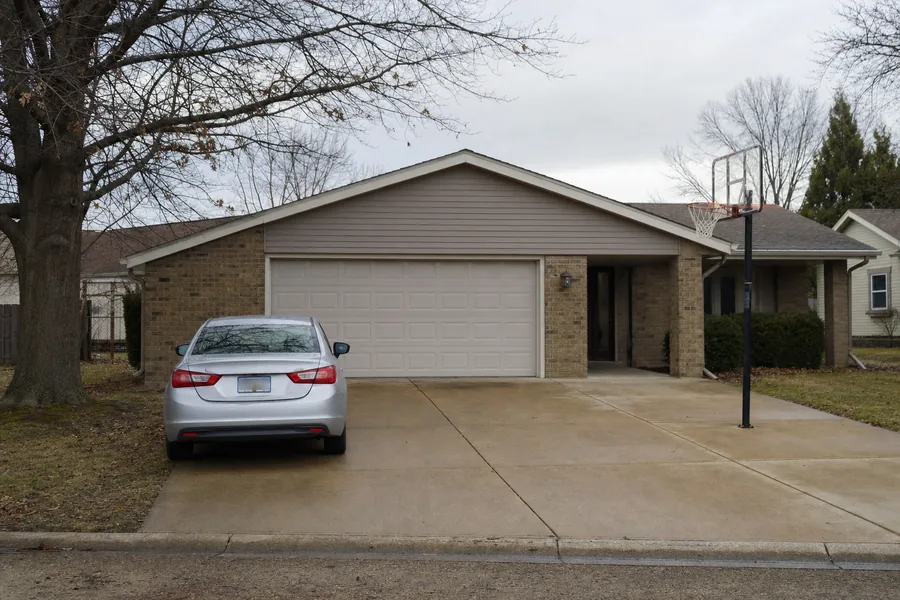
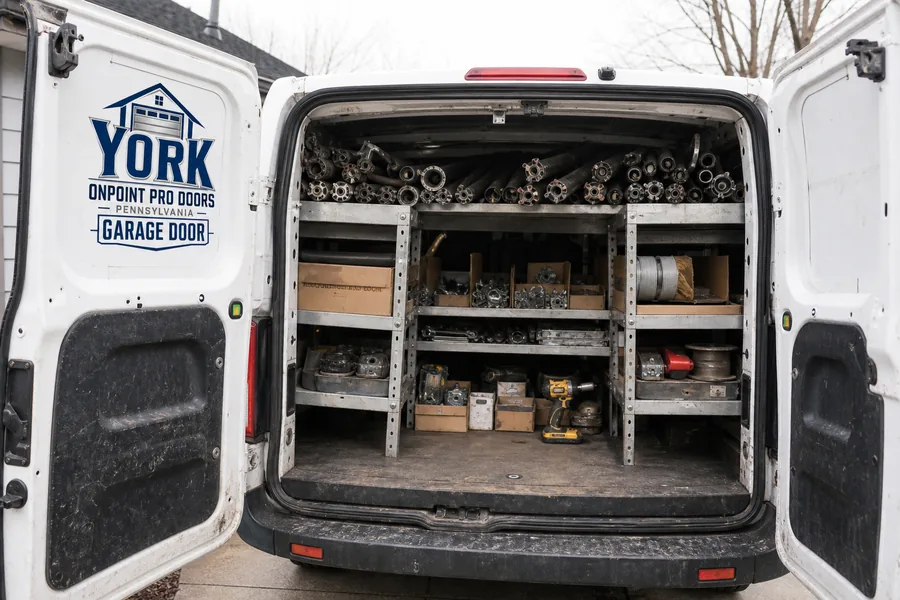
The same six jobs as everywhere else we work, with the parts for the doors common here already on board.
A torsion spring rated for 10,000 cycles will easily live 12-15 years in San Diego. That same spring in Pittsburgh, Erie, or Scranton typically dies between year 7 and year 9. The reason is freeze-thaw cycling. Pennsylvania, especially the Lake Erie snowbelt and the Allegheny Plateau, sees the temperature cross the freezing point dozens of times every winter. Each crossing puts microscopic stress on the steel as it contracts and expands. Over thousands of cycles, that stress accumulates and the steel becomes more brittle. Eventually a normal cycle (the door opens, the door closes) is enough to push the spring past its fatigue limit and it snaps.
Pennsylvania humidity is the second killer. That moisture works its way into any micro-crack in the spring's protective coating and oxidizes the steel underneath. Galvanized springs hold up much better in PA's wet climate, which is why we install them by default.
Road salt is the third PA-specific factor. Salt brought in on cars accelerates corrosion at the spring's termination points (where the wire is hooked to the cone or the bracket). Once corrosion eats away enough material at the hook, the spring cracks under normal tension. We see far more salt-induced failures in cars with attached garages where ice melt drips off vehicles every winter, especially in commuter towns along I-76, I-80, and I-83.
Most newer Pennsylvania homes (built 1995 onward) have torsion springs - the heavy steel coil mounted horizontally above the door on a shaft. Older PA homes, especially single-bay garages built before 1990 in row-home neighborhoods like South Philly, Pittsburgh's North Side, or older Allentown blocks, often still run extension springs - the long stretch springs running parallel to the tracks on either side of the door, anchored at the back wall.
Torsion springs are stronger, last longer, and balance more smoothly than extension springs. They also fail more spectacularly when they go. Extension springs typically just stretch out and lose tension gradually, leaving a heavy door that the opener struggles with.
If your home has extension springs and they're more than 10 years old, we'll usually recommend a conversion to torsion springs as part of the replacement.
When our technician arrives at your Pennsylvania home, the first thing they'll do is verify the spring failure (sometimes what sounds like a spring is actually a snapped cable, a stripped opener gear, or an off-track condition - diagnosis matters). They'll look at the spring shaft, count the springs (single or dual), measure the wire gauge with a caliper, measure the inside diameter and overall length, and weigh the door using a spring scale to confirm proper sizing.
Sizing matters enormously. A spring that's slightly under-rated for the door's weight will burn through its cycle life in 3-5 years instead of 12-15.
Before we leave, we re-engage the opener, run a full force-and-travel calibration on the opener, and walk you through what we did.
We will recommend replacing both springs even when only one has broken, and the reason is purely cycle-economics. Both springs in your door were installed at the same time, have done the same number of cycles, have aged through the same Pennsylvania weather, and are made of the same material. When one snaps from fatigue, the other is statistically very close to its own failure.
In those cases we'll document the recommendation in writing so there's no surprise if the second spring fails later.
Spring failures are our #1 dispatched-as-emergency call category in Pennsylvania, and we plan our daily route specifically to keep response times under three hours across York County. Calls received after 4 PM are typically scheduled first thing the next morning.
Emergency spring service (door stuck open, car trapped inside, or you're a healthcare worker / first responder needing access for a shift) gets priority dispatch 24/7 across York County. We've serviced springs at midnight in Hershey for a doctor heading to overnight call, at 4 AM in West Chester for a parent needing to get a child to the hospital, and on Christmas morning in Scranton when a snowed-in family realized their door was frozen and the opener had stripped its gear forcing it open. We don't promote the 24/7 number widely because it's reserved for genuine emergencies - but if you have one, call (484) 312-5999 and tell the dispatcher.
You can't keep springs from eventually fatiguing - they're consumable parts - but you can extend their life significantly with three habits. First, lubricate them twice a year with a proper garage door lubricant (white lithium grease or a dedicated silicone garage door spray). Spray the spring coils, the cones, and the bearing plates. Don't use WD-40 - it's a solvent, not a lubricant, and it actually accelerates wear by stripping the protective coating.
Second, get an annual tune-up. The tune-up adds 3-5 years to the life of every component on the door. We recommend booking it for early fall in PA (September-October) so the door is properly serviced before winter's freeze-thaw cycles begin.
Third, if you have an unheated detached garage in a cold-climate part of Pennsylvania (anywhere north of I-80, the Lake Erie snowbelt, the Pocono region), let us know during the install. We'll size up the spring gauge slightly to compensate for the additional thermal stress.
We dispatch spring replacement crews from rolling field positions across the state, which is why same-day response is realistic in nearly every PA metro. Our heaviest spring-call regions and what's typical there.
Three things that separate us from typical Pennsylvania garage door companies on spring jobs. First, we never do "while-we're-here" spring upsells. If your spring isn't broken and isn't visibly fatigued, we won't recommend replacement during a visit for something else.
If a spring we installed snaps within 5 years from any cause we contributed to (improper sizing, improper winding, improper bracket alignment), we replace it free. That includes parts and labor. Most PA garage door companies offer 1-year workmanship; we offer five because we stand behind our installs.
Wire gauge: undersized wire fails fast in PA's freeze-thaw. Confirm the gauge matches your door weight. Pair vs. single: any installer recommending single-spring replacement on a dual-spring door (when one has failed) is prioritizing their margin over your interests.
We're transparent about every one of these dimensions during the estimate. And we always recommend pair replacement when both springs are mid-life or older - even if you push back, we'll document the recommendation in writing so you have it on file if the second spring fails next year.
Free estimate. Same-day service across PA. Call now or fill out the form.
Around York, one call gets you a two-hour slot and a heads-up call before the technician sets off. We don't buy leads and nobody on a phone judges a door they can't see.
Free estimate across York, PA and the towns around it.
Say what's wrong and we'll commit to an arrival window you can plan around. The visit and the estimate is free, wherever you are.
Want to talk instead? Call (484) 312-5999.
Tell us what the door is doing. Nothing begins until you've heard the number, and hearing it is free.