OnPoint Pro Doors Pennsylvania replaces bent, cracked and rusted sections on alley garages, township split-levels and farm buildings around York, and tells you plainly when one new panel will do and when it won't. The estimate is free.
Tell us what the door is doing. Nothing begins until you've heard the number, and hearing it is free.
A sectional garage door is four or five horizontal panels hinged together, and each one rides its own pair of rollers. That design is the reason a damaged door doesn't always mean a new door: a single section can often come out and a new one take its place, while the rest of the door carries on as it was.
The panels don't wear evenly. The bottom one sits in whatever water and salt slush collects at the threshold, takes the bumper when someone misjudges the alley, and catches every ball kicked at the garage. The top one carries the opener's pull at the bracket. The middle sections mostly just ride along, which is why they're the ones that last.
Cracks tell a story too. A split running along a hinge line usually means the door was forced while something held it, often a frozen bottom seal or an opener pushing against a stuck roller, and that cause gets fixed along with the panel so the new one does not crack the same way.
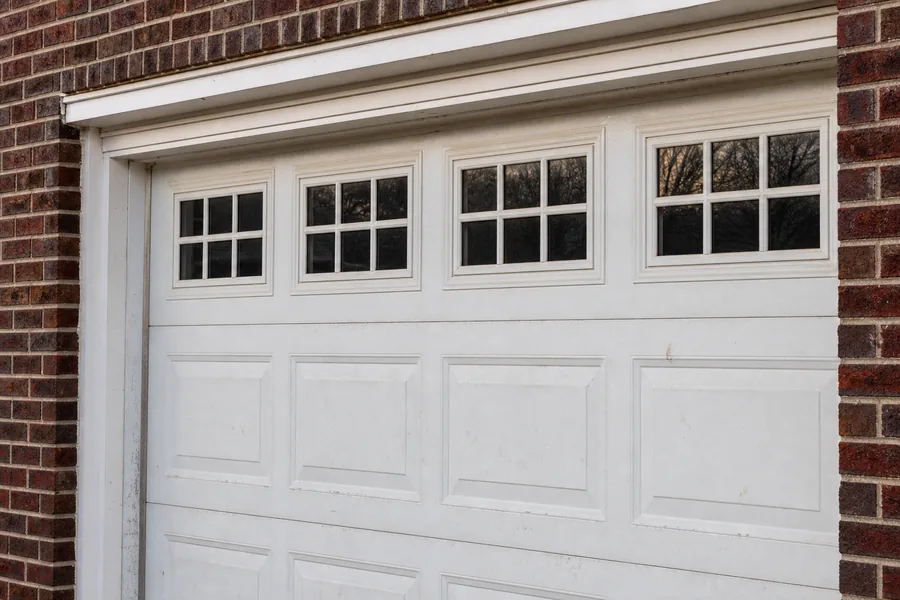
The top section is the one most likely to hold glass, and glass brings its own faults: a cracked pane, an insert that has gone cloudy, a frame that has worked loose from the steel. Sometimes the glass insert can be renewed on its own; sometimes the whole section is the cleaner fix, especially if the steel around the window has started to rust.
If you're changing it anyway, it's a fair moment to rethink the glass. Frosted or textured panes keep a rowhome garage private from the alley, and on a workshop out in the country clear glass usually earns its place. Either way the new section has to match the others in height and thickness so the door still closes flat.
A new section only works if the maker still produces that exact design: the same panel style, height, thickness and insulation as the rest of the door. The label on the inside of the door, usually near the bottom or on an end stile, tells us who made it and when, and that settles most of the question before anything is ordered.
Doors from a few decades back are often discontinued. Insulated and plain sections don't mix well either, since they differ in thickness and the hinges won't line up. And when two or three sections are bent, or the steel is rusting through along the whole bottom edge, swapping panels one by one stops making sense.
You hear both options at the door, with the reasons for each, and the free estimate lays them side by side. Nothing gets ordered until you've picked one.
A new section arrives with its factory paint, and the rest of your door has spent years in the sun and the weather. On a door facing south or west the difference can show, especially on darker colors. Most people don't notice it from the street once the panel is on the bottom row, but it's worth knowing before the order goes in.
If an exact look matters, painting the whole door after the swap evens it out, and textured woodgrain panels hide a slight shade difference better than smooth ones do. Carriage-style overlays and flush panels each come in their own patterns, so the pattern gets matched first and the color second.
Most section swaps take two visits: one to measure and order, one to install.
A new section seldom weighs exactly what the old one did. Rust eats weight away over the years, and an insulated replacement can be heavier than the plain panel it replaces. Since the springs are set to carry the whole door, a swap is always followed by a balance check, and the spring tension is changed to suit the door as it now hangs.
Wide two-car doors also carry steel struts across the back of some sections to stop them bowing. A strut that took the same hit as the panel gets replaced with it, and a door that was missing struts gets them, so the new section doesn't fold in the first windy storm.
The opener's force setting is looked at last. An opener tuned to an old, lighter door can push too hard on a heavier one, and that is how hinges crack.
Behind the city's rowhomes, trash carts and delivery trucks squeeze past garage doors every week, and a corner of a bumper is all it takes to crease a bottom panel. In the townships the trouble is slower: salt slush thrown up by the car sits against the lowest section through the winter, and the steel starts to bubble along the bottom edge.
Out on the farms, tall outbuilding doors take the occasional tractor or trailer backed a little too far. Those sections are bigger and heavier, and the hardware around them gets a close look when one is replaced. Old wood doors are the exception: matching wood sections are rarely still made, so a rotted wood panel usually leads to a conversation about a new door instead.
Often, yes. If the maker still produces that design in the same height and thickness, the bottom panel is swapped on its own and the door rebalanced afterward.
The maker's label decides it. If the design is discontinued, you hear that at the visit along with the options, including a new door, before anything is ordered.
The style and size will. The color can look a shade fresher than sun-faded panels, and painting the whole door afterward is the way to make it disappear completely.
A shallow dent is mostly cosmetic. A crease across the panel or a bent hinge line weakens the section and can throw the rollers off, so the technician tells you which kind you have.
Wood sections are rarely still made. Small damage can sometimes be repaired in place, but a rotted wood door usually ends up replaced, and you hear why.
The door's weight changes with the new section, and the springs are set to carry that weight. Without the adjustment the door can drift down or fight the opener.
Yes. The door is looked at, the options are laid out, and the free estimate comes before any panel is ordered.
Say what's wrong and we'll commit to an arrival window you can plan around. The visit and the estimate is free, wherever you are.
Want to talk instead? Call (484) 312-5999.
Tell us what the door is doing. Nothing begins until you've heard the number, and hearing it is free.